Showing posts with label Review. Show all posts

Wednesday, April 25, 2007

Album Review: Almost Killed Me

Ed note, this album actually came out in 2004, but it's new to me and, judging by its sales, especially when compared to The Hold Steady's next two albums, it would be new to most people.

Craig Finn begins The Hold Steady's debut album, Almost Killed Me, by softly summarizing, decade by decade, the last 80 years of 20th century American life. When he hits the new millennium the loud sloppy Thin Lizzyesque riffs that soak the next 40 minutes kick in and Finn calls out the "sniffling idie kids" to square us at 2004, before closing the opener by declaring "I got bored when I didn't have a band, so I started a band, man."

Now that he has laid out how we got here, and why he is here, Finn starts the next track, The Swish, by telling us exactly what he's going to be telling us about: "Pills and powders baby, powder and pills, we spent the night last night in Beverly Hills," Finn screeches and thus begins a journey of fear and loathing up and down the land he had just serenaded.

From Shaker Heights to Newport News to Ybor City to the mystical West Coast to Massachusetts to Michigan to the Twin Cities to the City of Brotherly Love nothing is left undrunk, unsnorted or unswallowed -- even things you've never heard of or couldn't imagine doing that with. Along the way you meet the bartenders and the bartenders' friends, the bouncers and the runaways, the cab drivers and the meth-cooking militia men, the hustlers, the ravers and, of course, the rock and roll band.

Steely Dan is the only other group I can think of that dives so deeply, and with such narrative aplomb, into the darkness that lurks when the good people have gone to bed. And while Becker and Fagen introduce you to the bumps in the night with the cool detachment expected from the studio virtuosos they are, The Hold Steady gets down and dirty like the beer-paid bar band they sound like.

Finn, the heart and soul of the operation, employs many tactics of the hack lyricist: He's found of rhyming words with themselves; he can't help recycling his best lines; he drops famous names incessantly; he repeats the name of his own band with the awkwardness of a NASCAR driver taking care of a sponsor; and he even undermines his own credibility by admitting he could be making it all up and that his characters are probably lying too.

Yet Finn pulls it off with the jaded assuredness of a beat poet and more than a touch of the postmodern "clever" he spends some of his own words railing against. So while the lyrical structure is a mess, and Finn's jumpy, sarcastic singing voice makes Bob Dylan sound like Mariah Carey, the mess works, and frames Finn as a story teller who can tell a story in a different kind of way.

The ten songs play out like the wild nights they immortalize: A long crescendo followed by a quicker fall. In Almost Killed Me's bittersweet closer, Killer Parties, Finn looks around to see who made it and tries to figure out what the hell just happened.

What did just happen is an album that announces itself with an 80-year history lesson has lived up to the promise of its audacious beginning. Not because it's important, or literary, or even that deep, but because it's outrageously fun. Which is what, above all else, music should be.

Almost Killed Me: A

Tuesday, March 20, 2007

We Were Dead Before the Ship Even Sank

Ever since I heard former Smith's guitarist Johnny Marr had joined Modest Mouse in an inter-generational, intercontinental pairing I could find no precedent for, I've been intrigued by this album. My interest grew when I learned the album would be titled We Were Dead Before the Ship Even Sank -- a neat amalgamation of the themes of mortality and disaster, and the crutch of pessimism, that lead singer and songwriter Isaac Brock has explored over his career with Modest Mouse.

Quasi-jilted enthusiasts tend to scrutinize Modest Mouse's surprisingly large body of work -- they have now released more songs than Led Zeppelin --for the point in time when the band "sold out." It's either 2000's The Moon and Antarctica or 2004's Good News for People Who Love Bad News, depending who's whining about it.

In anticipation of this album I've been listening to all sorts of Modest Mouse lately, and have reached the conclusion their overall quality has been pretty consistent. They do, on Good News For People Who Love Bad News, seem to speed things up a notch, and add that extra touch of bounciness the typical kid on Myspace would gravitate to.

Sure "Float On," the mega-hit from that album, might have once occupied radio space between Jessica Simpson and Hoobastank, but put that away and just listen to it and it sounds like a Modest Mouse song. Maybe a slightly sanitized Modest Mouse song -- but it doesn't sound like anything else.

We Were Dead Before the Ship Even Sank also bears Modests Mouse's unmistakable and idiosyncratic mark. The first time through I didn't even realize Johnny Marr was there, as Isaac Brock's vocals -- snarling and chanting as they always are -- are still very much the dominant instrument.

Two of the songs, "Dashboard" and "Missed the Boat," are clearly meant for Clear Channel and VH1, and that they are my two favorites so far aren't the strongest words to write on the album's behalf.

Although "Dashboard," in particular, is very high quality -- a modified fisherman's tale-- built around the sly refrain "would have been could have been worse than you would ever know."

Lyrically, Brock is an Absurdest with a penchant for circular logic and simple language. And this album is full of clever turns such as "like trying to save an ice cube from the cold," and "in the past speaking present tense."

Beyond the words, which are as adroit as ever, the songs have a tendency to blend into each other. A point that gets driven home when two of the more interesting songs on the album, "Fly Trapped in a Jar" and "Spitting Venom," radically change tempos and feels mid song -- a move Modest Mouse has always excelled at.

But that isn't happening enough from one song to another. If anything, it sounds like the band is sticking too much to their nineties formula -- and not employing the tweaks that re-cast the band as a major-label hit maker.

There is a reason few -- if any -- bands are as good in their second decade as they are in their first. Modest Mouse jumped into decade two by trying to be more things to more people, and that ended up giving them a freshness you don't often find from a band ten years in.

Modest Mouse seems stuck on this album. They aren't able to muster the stark rawness they once had on songs like "Cowboy Dan" -- and any songwriter is only going have so many "Dramamines" in him -- yet they don't fully embrace the more accessible option which worked extremely well on their last couple efforts. Making We Were Dead Before the Ship Even Sank a clear set back from a band with an otherwise excellent catalogue.

This is not a terrible album, and has almost as many good moments as blah ones. It's a portrait of a band at the crossroads: They can either go back to moving forward, somehow do a better job of going all the way back, or disappear into mediocrity -- or all together.

Only time will tell for a band which has already had more time than most.

We Were Dead Before The Ship Sank: C+

Wednesday, March 07, 2007

Album Review: Neon Bible

After Arcade Fire's performance on Saturday Night Live a couple weeks ago lead singer Win Butler smashed his guitar.

In this day and age when a band destroys their instruments you assume it is done in a Spinal Tap-like send-up of rock and roll excess.

But, since Arcade Fire is probably the least ironic band in the history of the universe, I'm pretty sure Win Butler meant it -- whatever it means.

When they aren't destroying the tools of their trade, Arcade Fire has worn their stone-cold seriousness well.

Their lyrics of overwrought love and loss, childhood fairytales, Bogeyman and vampires would be too much if you read them on paper, but are sold with conviction and an utter lack of self-consciousness.

They also had the perfect sound -- a big, huge pick your-influence wall of it -- to back up Butler's full-head-of-steam vocal delivery.

Two of their influences -- David Bowie and David Byrne -- adopted the band's debut album, Funeral, a few years back and helped propel the Montreal band to hottest-ticket-in-whatever-city-they-play status.

But Arcade Fire's latest release, Neon Bible, is not worthy of the pedestal they've achieved and deserve.

It does have a bunch of really good songs -- Black Mirror, Keep The Car Running, Intervention and Antichrist Television Blues make the album worth getting.

What it's missing, consistently, is the everything-but-the-kitchen-sink sound that powered its predecessor. No longer are we treated to epic compositions of their over-the-top interpretations of Bowie glam riffs, backed by the driving drum-and-base of a New Order dance hit, backed by all sorts of bells and whistles and horns and strings.

In some of the songs on the album they seem to be taking a page from other contemporary bands, such as Hold Steady and The Killers, by channeling Bruce Springsteen -- at least vocally. Or, more precisely, they sound like Eddie and the Cruisers, the fictional movie group from the 80's that evoked The Boss.

There is nothing wrong with Springsteen (or Eddie and the Cruisers.) It is just a weird place for Arcade Fire to be.

Like Arcade Fire, Springsteen makes serious music. But he can also be subtle and clever and, yes, ironic. Which is why his albums are generally successful from start to finish.

Arcade Fire can be none of these things. They are the very embodiment of the phrase "go big or go home."

All too often on Neon Bible -- an album which has its moments -- I wished Arcade Fire had stayed home.

Neon Bible C+

Monday, February 26, 2007

79th annual Academy Awards

It was a good night for Martin Scorsese, the Spitting Image puppet that ate Al Gore (and everything else) and bearded Mexican men.

You are forgiven if you forgot the part about the bearded Mexican men. They starred during the first third of the telecast, the part dominated by technical and artistic awards. Unfortunately, the whole show wound up pushing four hours.

For all I know it was the same bearded Mexican man holding up Oscar again and again. Or maybe it was a Spanish man. If host Ellen DeGeneres, who introduced herself to the world-wide audience by flubbing Penelope Cruz's place of birth, can't tell her Spaniards from her Mexicans why should I be able to?

Overall, I thought DeGeneres overcame paper thin material to do an OK job. That is a well-qualified OK. Since I'm not schooled in her comedy, I'm not sure if she is always this minimalistic in her approach, or if she was told by the Academy to dispense with any proper joke writing or topical references and instead just humorously putter about -- which she did.

Speaking of a show about nothing, Jerry Seinfeld, who presented crowd favorite Al Gore's film An Inconvenient Truth the Oscar for best documentary, strikes me as a perfect candidate for a future Oscar host if the Academy wants to play it safe like it did tonight. We know Jerry has the time, and there is nobody better at making the benign hilarious without losing his edge.

But, as you always realize when you watch the Oscars, after the opening monologue the host becomes a very small part of the proceedings.

This wasn't a great year for the movies critically, and only few of the films nominated for best picture or the acting awards made the slightest dent at the box office. So to redeem itself and the year the Academy needed to give Scorsese the individual recognition that had eluded him for so long.

With The Departed already grabbing trophies for adapted screenplay and editing, and with Spielberg, Coppola and Lucas -- the three other faces on Scorsese's generation's directorial Mount Rushmore -- picked to present the best director trophy, there was even less suspense than there would have been otherwise. And even less than that a few minutes later when The Departed took the ultimate prize.

It was a bland night without a signature moment or any surprises -- save a hairless Jack Nicholson and the reminder that Reese Witherspoon is an Academy Award winning actress.

And, yeah, it was way too long. Only I don't know what the producers could have done to make it that much shorter.

The speeches and presentations were kept to a minimum. When the third part of the winning best sound mixing trio attempted to add his thank yous not only did the music play but a large man slid into the frame.

I tend to like the movie montages and, whatever I think, the musical performances are here to stay.

I guess the honorary lifetime achievement Oscar -- the one where Clint Eastwood forgot his glasses and the honoree forgot how to speak English -- could have been (and should have been) chopped.

Of course the best way to shorten the telecast, and alter it radically, would be to get rid of all the art direction, make up and sound awards. Talented bunch or not, if entertainment value is valued what is the logic in giving such an obscure group of people such an incredible audience?

This year axing the technical and artistic awards wouldn't have gone over well in Mexico. Or was it Spain?

But it would have allowed the rest of us more time to appreciate the wizardry of the human shadow puppet. And cherish the first stop on Al Gore's beg-me-to-run-for-president tour. Who knows, Gore may still have them begging by the time the 2008 Oscars roll around. Unless that great wave of former icebergs sweeps us all away.

Such a fate would be a tiny bit less tragic, now that Scorsese has his Oscar .

Thursday, February 15, 2007

Album Review: Writer's Block

The word is Sweden, a nation of nine million, trails only the United States and Britain in terms of musical production. What that means and how it is calculated, I haven't a clue.

I do know from ABBA to the Cardigans to their garage rock revival bands such as The Hives and Mando Diao to even the insidiously catchy, if musically questionable, Backstreet Boys/Britney stuff of the late 90's -- which was actually being pumped out of Swedish song factories -- the Swedes seem to have a compulsion to make music you want to sing along with.

When I first come across the single Young Folks, I thought to myself: this is catchiness like I haven't heard in some time. When I noticed the name of the band was Peter Bjorn and John, the Bjorn spoke to the legacy the band was continuing.

Young Folks is a first person boy/girl duet in the spirit of the Human League's 80's smash Don't You Want Me Baby. Although where that song focused on a relationship gone stale, Young Folks explores its first few cautious steps. The lyric is angst-ridden and tentative, and when that doesn't contradict the driving drum beat the song is built upon, and the greatest whistling intro since Axl Rose presented Patience, it compliments them perfectly.

With their first American hit under their belts the band has just re-released their latest album, Writer's Block, and embarked on a North American tour.

Off the bat, what surprised me about Writer's Block is how much feedback and guitar noise are present on early tracks like Objects of My Affections and Start to Melt -- which wouldn't be out of place on a The Jesus and Mary Chain record. This is quite a contradiction to the clean, sparse sound of Young Folks.

But it is a good thing. The album takes its thematic cues of relationships and fear and longing from the hit single, but puts forth quite a diversity of sound in its execution.

A lot of this comes from PB&J being a group of three singers and songwriters. Peter, who can sound a little like early 60's rocker Del Shannon, handles the bulk of the singing, but Bjorn and John, who sound like Swedes singing in English, make contributions which, upon multiple listening, become just as relevant.

Really, the only part of the album I don't like is Poor Cow, the whiny clunker that closes the show. Songs like Objects of My Affections, Amsterdam and Paris 2004 should be heard far and wide.

Scandinavians, with their long dark blankets of winter, can be angsty in their artistic expression. In Writer's Block Peter Bjorn and John take that Northern burden and mix it with their particular Scandinavian country's proud history of making some of the most infectious music in the world. It works and works well.

Writer's Block A-

Tuesday, February 06, 2007

Album Review: Wincing the Night Away

Like many before and many since, the first time I heard The Shins I was taken in by their bittersweet vocal melodies, lush harmonies and their songs' old fashioned AM radio length. It immediately evoked The Beach Boys.

This popular analogy doesn't hold up if you listen to The Shins and The Beach Boys in proximity -- they sound nothing alike.

The perception that they do says something about the record companies' and the marketplace's (and possibly those who make music's) strange hostility towards well-written, melodic pop songs that aren't guitar or synth driven.

So while The Shins first two albums garnered critical acclaim and a relatively large following for a band not signed to a major label, they weren't able to achieve the widespread popularity their easily accessible, universally appealing sound deserved.

That began to change when the movie Garden State became a surprise hit in 2004. In the film, Natalie Portman's character recommends The Shins by name and declares that the song "New Slang" -- which was featured prominently in the movie -- will change your life.

It seemed an odd thing to say about The Shins, whose understated style suggests they might be the last band in the world who would want to change your life.

Regardless, that mention -- and the fact New Slang happens to be a terrific song -- raised The Shins' profile considerably.

Many speculate it was increased expectations that led to the four year gap between their second and third album. But increased expectations proved to be a sign of an increased fan base and last week Wincing The Night Away opened at number two on the Billboard album chart, moving 118,000 units -- an unusually large first week count for a band not signed to a major label. In fact it was the biggest opening week ever for a band on the venerable indie label Sub Pop.

If Wincing The Night Away had been the first Shins album I had ever heard, I would have never thought to compare them to the sun-stained Beach Boys. The album's title references insomnia and, off the bat, this is a darker and more searching effort than the previous two.

As the album progressed I also noticed increased reliance on synthesized beats -- not necessarily a good development, since they had been doing fine without it.

Still, this is unmistakably The Shins. Singer and songwriter James Mercer, whose vocal influences are firmly planted in the British bands -- such as The Smiths and Echo and The Bunnyman -- of the post-punk era, still defines his songs with his unique talent for stretching certain words and syllables to make his lyrics fit with the music.

And, despite being inspired by the frustration of endless days, the album is still sweeter and more whimsical than most music you come across. This is especially evident on songs like "Phantom Limb," Turn On Me" and "Girl Sailor."

The Shins' secret weapon is the quality of their lyrics, which often gets lost in the tightness of the overall package and the hypnotic nature of Mercer's well-measured delivery.

Mercer is at his lyrical best when he writes in simple words and explains simple ideas, often using of pieces of idioms or words that you've heard together before in new contexts. (As in their previous albums he seems to have a particular fascination with horses and sacks.)

Mercer -- who is pushing 40 -- has written a mature album. But luckily his youthful pop impulses can't be fully suppressed, making his maturity bearable at worst and interesting at best.

With their new found audience, maybe the next time an American band with a clean, melodic pop sound and preference for vocal harmonies over guitar solos emerges we will all think "this sounds like The Shins."

Even when it doesn't.

Wincing The Night Away B+

Wednesday, January 31, 2007

Album Review: Some Loud Thunder

Released in 2005, Clap Your Hands Say Yeah's eponymous debut came during a time the snobbish indie taste makers were still using the Internet without self consciousness. Meaning even someone like myself quickly learned of the luminous praise for the idiosyncratic band from Brooklyn and Philly that was -- suddenly -- underground and mainstream.

Skeptic as I am, I dismissed this new kind of hype and the band with the strange name. Finally, after prompting from ear-witnesses I actually knew in the original world, I downloaded it. Damned if didn't justify every word that had been posted about it. The album is a classic. If there has been a better rock album this millennium, I'd like to hear it.

CYHSY's second album, Some Loud Thunder, was released yesterday amongst less fanfare. Some of the singles have been available on the net for months, but they weren't overwhelming enough to spark the band's original advocates into action.

The album begins with the the title track, and it is a very good song. The only problem is someone -- maybe new producer Dave Friedman of Flaming Lips' production fame -- has added distortion to most of the song's tracks. It sounded so off that, being the first song, I thought there was something wrong with my download.

One of my favorite things about the first album was how clean it sounded. Each note pierced and stood on its own. But, as the first song demonstrates in the extreme, the follow up is a much murkier affair. This is an unnecessarily self-inflected wound.

Nevertheless the first half of the new album is quite good, culminating in Satan Said Dance, a tribal disco stomp begging to be remixed ten ways to the nearest discotech. It is also the only song that would stand out on the first album.

The second half of the album is not good. It's not that it's bad. I even suspect, over time, I will begin to like the two longer songs that close the album. The problem is lead singer Alec Ounsworth's jumpy sarcastic wail, which intrigued me so much the first time around that my favorite part of the album might be him repeating the phrase "child stars" (although it sounds like a million other things) over and over for 45 seconds, just sounds bored this time out.

I'd still recommend this album to anyone who liked the first, and recommend the first to anyone who likes music.

But it's hard for me to judge this album on its own merits: I may be overrating it because it reminds me of something great, or I may be underrating it because it doesn't remind me enough.

I'll just give it a B and move on.

Wednesday, December 13, 2006

The Wire

I started watching The Wire this season because of the parade of critics -- professional or otherwise -- who had declared the barely watched crime drama the "greatest show in the history of television." I figured, if nothing else, my viewership would help bridge the paradoxical gap between praise and audience.

After watching the season finale last night I'm not prepared to part with my greatest of all-time tag -- the twelve episode season sagged considerably in the middle, and my greatest of all-time wouldn't do a thing like that.

But I am certainly willing to anoint The Wire the best show I've seen in years.

I won't even attempt to explain what went on in season four. One of The Wire's endearing attributes, especially when compared with HBO's more popular crime drama, The Sopranos, is that lots of things happen. If you haven't seen the show and want to learn more about the details
check out its website.

The reason you do want to learn more about The Wire is that it's compelling story telling that never sentimentalizes and rarely moralizes -- despite being loaded with material that usually gets that treatment.

And, despite a completely unknown cast, the acting matches the writing. The acting is so good it calls into question how difficult acting really is. At the very least it proves there is a deep pool of undiscovered talent that can perform at the same level as the famous faces you usually see.

So you can mostly believe The Wire hype. If you haven't seen it, check it out on DVD and spread the word.

Wednesday, November 15, 2006

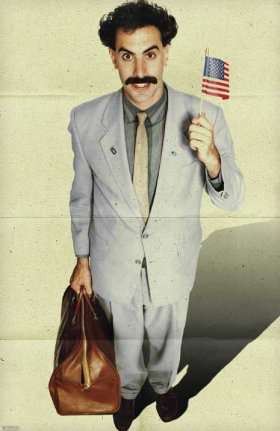
Snap judgement: The Borat Movie

Sacha Baron Cohen's smash hit Borat: Cultural Learnings of America for Make Benefit Glorious Nation of Kazakhstan was able to dominate the news cycle in the run up to its release. It has been in the spotlight ever since, lately with a report that Cohen, in Borat character, was assaulted in New York, and with the news of lawsuits both tricked Eastern European villagers and fooled American frat boys are bringing against the film's producers. (We're not that different after all!)

There has also been a parade of ruminations from reviewers and public intellectuals on what the movie and the movie's success means: Are Americans gullible fools? Could there be pogroms in the "exceptional" USA? Is the whole thing a joke, and the laugh is on the red states?

I watched the hilarious film last night and can report that not only aren't these questions answered but they aren't even addressed. Anyone who says otherwise either didn't see the movie -- but did see the harder-edged Borat sketches on the Ali G show -- or brought their own preconceived notions into the film and didn't bother to consider what was happening on the screen.

The only broad conclusion I could draw from Borat, the movie, is Americans are very tolerant of a foreigner and his odd customs until those odd customs breach human decency, and then they begin to lose patience with the customs and the foreigner. Not exactly an earth shattering revelation.

The film did contain one truly shocking scene involving a prolonged, very naked wrestling match between Cohen and his rotund male co-star. Even if you know it's coming and expect the worst, you will not be prepared for what goes on. I always thought the hands-over-the-eyes move was an affected one. Now I know it can be an uncontrollable impulse.

Cohen is doubly blessed as a wit and as a fearless physical comedian. He leans heavily on the latter in Borat's feature film debut. It's not necessarily a bad thing: If the film's ratio of laughs to minutes was any higher, the audience would have trouble breathing.

Actually the dumb-downed Borat's success in America and everywhere else does suggest something surprising: If properly marketed, a remake of The Three Stooges could also strike world-wide box-office gold.

If properly made, it could be pretty darn funny too.

Friday, September 15, 2006

Snap judgement: Bill Simmons on the TV

It has become vogue, among espn.com's Bill Simmons's 18-35 male demographic, to say or write something along the lines of "The Sports Guy used to be great and he got me into writing/blogging/fantasy football/David Ortiz/Texas hold 'em/the OC, but now he sucks and just recycles old columns."

To drive this point home a
write your very own Sports Guy Column generator is floating around the Internet. It's kind of a reverse Mad-libs deal and, if you have about 15 minutes, it works surprisingly well.

While I agree Simmons tends to touch on the same themes and uses the same format over and over he is also burdened with having about five years of intensely scrutinized about-weekly "8000" word columns. (Another of his not-so charming attributes is he rarely gets through a longer-column without a bragging reference to its massive word count.)

Despite his volume and repetitions, I continue to read almost every word Simmons writes, still think his ability to mix sports and pop-culture is second to none and remain surprised when one of his columns doesn't make me laugh aloud a few times.

But there has been something eating me about Simmons lately: He continues to offer Bill Simmons the man, not the talented writer, as a male etiquette expert in situations like a fantasy football draft, a blackjack table, a night at the bar, a relationship etc. Yet, I don't think he has ever made the case that he is worthy of handing down these Miss Manner-like scoldings to the less-socialized.

What makes Bill Simmons unusual among "celebrity sports columnists" is he almost never appears on television. The only time I have seen him on TV was one of those VH1 I Love the (insert the decade) programs. He was just on screen for about ten seconds and I don't remember what he commented on. Either his clip was shot in a studio with different lighting than all the other commentators or the CRT radiation from the monitor he has been sitting in front for the last decade has rendered his skin translucent, because he appeared as hair floating ten inches above a headless body.

I would have thought his move from Boston to LA a few years ago and his affiliation with late-night host Jimmy Kimmel would have produced more TV appearances but, so far, none that I know of.

So it was with great anticipation I watched Bill Simmons' appearance on the Colbert Report last night. Would he be the comfortable-in-his-own-shoes man's man he suggests in print or the squeaky-voiced geek many suspect he is in person?

So excited was I for the prospect of an answer to this transcendent question I put post-it's stating "Comedy Central" and "11:30" all over my apartment to neutralize my habit of forgetting to do things I fully intend on doing.

My was I disappointed. Not in Simmons, but in the interview as a vehicle to solve the Bill Simmons' mystery. It was only couple minutes long and Colbert, as is his act, spoke over Simmons the whole time.

Simmons' hue was more normal. His voice was a little squeaky, but he did speak confidently. When he was able to complete a thought -- he offered an anecdote about Bush throwing out the first pitch in Yankee stadium after 9/11, there was the obligatory discussion of Red Sox nation, and a quick suggestion of how to improve USA Basketball -- he was mildly insightful. Yet nothing was revealed or solved.

Although I fully expect a 8000 word report next week, complete with a checklist of how to behave as a guest on a talk show.

Wednesday, September 06, 2006

Snap judgment: Snap judging Katie Couric's debut

I don't watch the morning or evening network news and didn't start last night so much of this Katie Couric hoopla has gone right by me. My only opinion of Couric, the carefully presented celebrity personality, is that she reminds me of a chipmunk. A fairly attractive chipmunk, but a chipmunk nonetheless.

The CBS-manufactured hype surrounding Couric's first night in the CBS Evening News anchor chair has compelled just about
every television critic and cultural commentator to go through her debut with a fine-toothed comb -- with some of them drawing fairly broad conclusions.

While I understand it wasn't the reviewers' decision to make this an "event," as an event, was it really any different than the first game of a just-up-from the minors hot-shot shortstop with a long career in front of him?

Maybe not exactly the same-- there were also non-Couric changes to the newscast's format -- but a lot more like the shortstop than the movies, television shows, books or even political speeches these journalists would typically be reviewing. Rendering some of the more definitive conclusion I read out of place, and almost inappropriate.


Also, since much of the controversy surrounding Couric focuses on whether or not she has the gravitas to pull off the evening news, isn't a day in which the biggest story was the death of a crocodile hunter a tough one to solve anything relating to this debate?
Cronkite had the Vietnam war and Watergate to prove his mettle. If he didn't he wouldn't be Cronkite.

I'm not crying for Couric's mostly poor to mediocre early returns, but if the punditocracy thinks Katie Couric's performance on the CBS Evening News is worthy of their attention they should also revisit the topic in a few months when she has established more of a body of work.


*After reading about ten reviews, it seems like half the reviewers got this, and held off straying too far from straight reporting, and the other half reviewed like it was the final word on Katie Couric and nighttime news.

Friday, September 01, 2006

Snap judgment: 2006 MTV Music Video Award

Ever watch the Oscars or the Grammys and think to yourself "this really sucks"? If you have, you need to check out the annual MTV Music Video Awards. It will completely change your perspective on awards shows and sucking.

It was with that attitude I took in about 45 minutes of the 2006 MTV Music Video Awards. I was particularly looking forward to being the who-the-hell-are-these-people curmudgeon as MTV inevitably unleashed one flash-in-the-pan no-talent performer after another.

So, I was quite thrown when I turned on the TV and there was
Lou Reed singing a song from his Velvet Underground days. Reed looked good for that rock and roll milestone of 64, although his presence had thrown the audience too, and they seemed quite worried.

The show was hosted by
Jack Black, a fairly talented, mostly physical comedian who never blinks his eyes. Ever. He also didn't seem to mind that he was performing on a stage that looked, to the television viewer, like two-and-a-half giant penises.

Soon, Black introduced
Lil' Kim, who had just been released from prison. The audience cheered her return to freedom. The crowd cheered even louder when Lil' Kim thanked her "peeps" for sticking with her through her incarceration ordeal because, you know, the whole having friends sticking with you when are in prison is something Ivy league music executives and their plus ones can really relate to.

They started giving out awards. I can't remember who won. But I can remember who didn't win. That would be
Kanye West. The camera caught each of his smiles-through-gritted-teeth. It would have been nice if Jack Black cracked an "I guess MTV doesn't care about black people joke," but he didn't. No matter, everyone was thinking it.

The lowlight of the evening for me was when
50 cent and LL Cool J were called on to present an award. It started innocently enough. One of them would say "yeah" and then the other one would say "make some noise." This went on for a while, but when they actually started speaking real sentences 50 unleashed a verbal gaffe that will forever change the way I look at the hip-hop-artist.

Describing some sort of musical journey, 50 said "From Texas to Michigan to Detroit to Canada."


Now I have always admired rappers for their flawless senses of geography. And, as a fan of geography myself, it has always pleased me that the typical rapper is so ready and willing to display his geographical skills lyrically. Yet 50's Michigan to Detroit blunder leads me to believe this geographical mastery is nothing more than studio wizardry. A sad day.

In conclusion, I can't say the 2006 MTV Music Video Awards didn't provide me with 45 minutes of commercially punctuated distraction. But I also can't say it was any good.

Wednesday, August 30, 2006

Deadwood wrap up

This summary is not available. Please click here to view the post.

Monday, August 28, 2006

Entourage wrap up

In season three Entourage did a good job of living up to the hype it generates in the 18-to-35 male demographic. It remains the most deliciously voyeuristic show on television -- a neat trick for a scripted, professionally acted show in the age of reality TV. Entourage might make you hate your own life and curse your friends for not becoming movie stars but, as you watch, you are tricked into having fun doing so.

The key to Entourage is the defiant way the five main characters don't evolve. Rather they are just thrown from one fortunate situation to the next and react exactly the way you would expect them to. A life of hedonism with nary a lesson learned -- it's no wonder the show is such a hit with the audience it attracts.

My favorite development from season three was the increased willingness to separate Vince, Eric, Turtle and Drama from their famous lock-step and let them develop their own plot lines. Los Angeles provides ample venues for the famous and almost-famous to find the type of adventure that doesn't lose any of its entertainment value, over the course of a twenty-five minute episode, when alternated with other adventures at different venues.

As always, Entourage offered up a parade of guest stars to contribute to the beautiful bustle. This season they kicked things off with the disastrous friend-from-the-old-neighborhood Dom, who, in a brief amount of screen time, proved that a violent amoral character can also be painfully unwatchable -- a TV and movie first. I am not sure if the part of Dom was just written and acted that poorly, or if the producers included him for a couple episodes to make everyone appreciate how much better the show is without him.

On the other hand
Martin Landau's portrayal of the Robert Evans-inspired over-the-hill producer Bob Ryan was -- along with the continued hilarity of Johnny Drama -- the high point of season three.

With Ryan's "what if I were to tell you . . . would that be something you might be interested in?" catchprase establishing itself as TV's most popular since "I'm Rick James, bitch," it looks like I wasn't the only Entourage fan won over by the lovable codger. (Although Robert Evans
certainly isn't on that list.)

Yesterday's finale ended with an intriguing cliffhanger, virtually assuring season four will come on the heels of "TV event of the year" buzz. I will be looking forward to seeing if they can live up to it.

Tuesday, August 15, 2006

Snap judgment: The New MNF Team

After thirty-six years, Monday Night Football has departed Disney's ABC flagship for its cable network, ESPN. A complete revamp of the broadcast booth accompanied the transition.

Most of the focus has been on the new color commentator -- television, radio and newspaper personality Tony Kornheiser -- but Mike Tirico and Joe Theismann were also added to football's most venerable night.

Tirico is best known for his PGA play-by-play and
sexual harassment. Theismann is best known for being hated by everyone including, improbably, fans in the Washington DC area where Theismann once led the local Redskins to their first Super Bowl title.

When the new booth was announced I was concerned neither Theismann nor Tirico had what it takes to be Kornheiser's prime time
Wilbon, and the whole enterprise was going to sink in a Dennis Miller-like debacle.

I watched last night's pre-season match up between the Oakland Raiders and Minnesota Vikings with my eyes and ears nervously on the nascent broadcast team.

The three eased my mind by handling the opening like they had been doing it for thirty-six years. Their remarks were prepared and smooth. My sole complaint was Kornheiser's bad posture. A few times part of his head swayed out of the picture.

It was mostly Tirico for the couple of possessions because when the line-ups are being announced there isn't much opportunity for the analyst and color guy to jump in.


Monday night's new play-by-play man is inoffensive and stays on top of things. My only qualm is his golf voice might lack the animation needed for football. It would be advisable for ESPN to place a female intern in Tirico's sight line and then make her bend over and pick things up during big plays and touchdowns.

Kornheiser and Theismann joined the fray during the third possession. Despite a couple of superfluous flubs, Tony was on-point and every bit the wit he was expected to be.


I have to admit, Theismann's analysis was thoughtful and delivered concisely. Maybe it was because the Monday night venue reminded me of a prime-time match-up twenty-one years ago when Lawrence Taylor snapped Theismann's leg in half and ended his annoying career, but Theismann's skills in the booth rated a pleasant surprise.

Theismann and Kornheiser engaged in a couple of well-paced, informative debates. At times they almost seemed practiced. Although, if that's the worst criticism of their first-time on-air chemistry I'd say they are ahead of the curve.

While it was only a pre-season game and I only watched the first quarter, as long as Kornheiser didn't fall asleep in the second half -- as he had threatened to do -- their debut was a success.


Monday Night Football is no longer terrestrial-grade but it should continue to be must-see TV.

Friday, August 04, 2006

They still want their MTV

MTV turned 25 this week. It barely resembles its newborn self.

When I first watched MTV, in 1984, I thought it was coolest, most unique thing in the history of the world. It was a friend's house situation, and he was forced to do nothing but watch MTV when I came by.

Back then, MTV was a couple dozen videos on a loop. Some were surprisingly
good, others predictably bad.

It has been years since the music video was MTV's bread and butter. But they've done everything else: Game shows, talk shows, sketch comedy, cartoons, documentaries, movies, anything involving warm places and bikinis, dance contests, dating shows, softball games, live music, atrocious but star-studded awards shows, political debates, extreme sports, movie reviews, auto restoration, house tours and daredevil behavior.

About half-way through its existence MTV introduced America to
reality television. Neither MTV nor America has looked back.

Reality TV has been MTV's biggest cultural accomplishment to date, even though the "M" suggests it wants to be the music video.

I barely watch MTV these days, but have seen enough to notice they have been taking the reality format to its next logical step by producing shows that merge "real" people with blatantly scripted stories and more traditional production values. I'm sure this will soon catch on with the rest of the TV world, just like their early reality shows did.

I wonder if a kid today is as blown away the first time they see
Laguna Beach as I was when I saw Duran Duran?

I seriously doubt it. But not because the videos got small. It was the world that got big.

Wednesday, June 28, 2006

Snap judgment: The View

Regular readers of JSB know I've been watching the World Cup during lunch. I obviously haven't been following the tournament closely enough because I had no idea there weren't any matches scheduled for today. I figured this out only after toggling furiously between ABC, ESPN and ESPN2 for a good five minutes.

In absence of soccer, I settled on watching
The View. Yesterday and this morning there was all sorts of hoopla surrounding a Barbara Waters/Star Jones feud that seems to have resulted in Jones abruptly quitting the show. How could I resist trying to figure out what the fuss is about?

Walters was not on the set when I tuned in 2/3rd's of the way into the hour-long show. It was mid-segment and a family of models were displaying the latest summer fashions. Co-host Elisabeth Hasselbeck, the attractive wife of the
more hair/less playing time brother Hasselbeck, was seated on a couch, interviewing an older, blond stylist whose revelation that each outfit was less than 70 dollars made the audience coo.

The stylist was also having some kind of effect on Elisabeth Hasselbeck. Elisabeth appeared flustered and couldn't stop touching her hair. The bar-room psychiatrist in me couldn't help thinking she might want the older woman's hotel room number. The more it happened, the more uncomfortable and weird it became to observe.

Luckily, co-host Joy Beher cut in with a joke about the models and their coordinated outfits that went along the lines of "a family who dresses alike doesn't have to talk to each other."

The audience laughed. Elisabeth and the stylist laughed. I laughed. Good times.

For the next segment someone named Dr. Ian Smith, who had a technique for losing 9 pounds in 8 days, was announced. The audience squealed. Ian Smith, I ruminated. Why does that name sound so familiar?

Former Prime Minister of Rhodesia! (Still alive and kicking,
btw.)

I didn't really expect that Ian Smith, but when a handsome young black man sauntered onto the stage I realized this was another Ian Smith I had prior knowledge of. In fact I had just read a
gossip item alleging this Ian Smith was having a homosexual affair with New York Giant great Michael Strahan. The alleging was technically coming from Michael Strahan's soon-to-be-ex-wife during a contemptuous divorce proceeding, but they printed the allegations in a real, dead tree newspaper so there's got to be something to them...

The wife of a backup quarterback and the gay lover of an all-pro defensive end sharing the same stage? They should replay The View on the NFL Network!

Dr. Smith didn't have much to say. His diet sounded suspiciously like the Atkins diet and I thought we had stopped doing that when an autopsy discovered Dr. Atkins arteries were more clogged than the Lincoln Tunnel.

The highlight of the rest of the segment was a joke Joy Beher made about how much she likes to drink.

In the last segment Barbara Walters made her first appearance, sitting down round-table-style with her two remaining co-hosts. Maybe all the press about her feud with the departed Star Jones had got to her, because Barbara looked all serious and journalisty -- like she was really sitting down with Nixon and Kissinger. Walter's inquiring glare made Hasselbeck tap her fingers nervously, but Beher casually cracked more jokes about getting drunk. Leaving me to ponder if Beher just went where the laughs are or has a serious drinking problem.

That was it. The View is not targeted to my demographic and I will not be going out of my way to watch it in the future. Nevertheless, my twenty minutes with The View were highly entertaining and I recommend it to anyone who has the time and the urge to watch late-morning talk shows.

The best part for me?

No nauseating diving during lunch.